Your child has started learning letter sounds, and now you're looking for books that can help them practise reading.
You search online and find hundreds of options.
Some books say "phonics." Others say "early readers," "sight words," or "Level 1."
They all look colourful, but how do you know which one your child actually needs?
The answer isn't always the book with the most illustrations or the biggest age label.
The best starting book is one that matches the reading skills your child already has.
This guide will help you choose suitable phonics books, avoid common mistakes and understand when to introduce workbooks.
What Makes a Good Phonics Book for Beginners?
A good beginner phonics book helps children connect letters to sounds and use those sounds to decode words.
Look for these five features.
1. A Clear Progression of Sounds
Beginner readers should introduce phonics patterns gradually rather than expecting children to know many unfamiliar sounds at once.
For example, a child might first practise short-vowel words such as cat and pig before moving to more complex spelling patterns.
This gradual approach gives children opportunities to practise what they've already learned.
2. Words Children Can Actually Sound Out
A book may have only five words on a page but still be difficult for a beginner.
Check whether your child has learned the letter-sound patterns used in the story.
Books with suitably decodable text allow children to practise rather than rely entirely on memorisation or guessing.
Parent tip: Before buying a phonics book, look at a sample page and check how many words your child could sound out using their current knowledge.
3. Short, Manageable Stories
Children beginning independent reading may benefit from shorter passages.
Finishing a small story with support can feel more manageable than facing a long page of text.
Start with a few simple words or sentences, then gradually introduce longer stories as your child's skills develop.
4. Interesting Content
Reading should still be enjoyable.
Look for stories with appealing characters, situations or illustrations that invite conversation.
Decoding practice and enjoying a story can happen together.
5. Practice Materials, If Needed
Some children enjoy additional word-building, spelling or writing activities.
A workbook can complement a reader, provided the exercises match the spelling patterns being taught.
You can explore different options in the Phonics Collection at VIDYA VITRAN LEARNING.
Phonics Readers vs Workbooks: What's the Difference?
Parents often wonder whether they should buy a set of reading books, a workbook or both.
Here's a simple comparison:
| Phonics Readers | Phonics Workbooks |
|---|---|
| Practise reading connected text | Practise targeted skills |
| Help children apply decoding in stories | May include spelling and writing |
| Provide opportunities to build reading fluency | Can reinforce sound-letter patterns |
| Encourage reading habits | Offer structured written activities |
For a child learning to decode, actual reading practice is essential.
Workbooks can be added to reinforce the same sounds, words and spelling patterns.
You do not necessarily need both products to get started.
Looking for reading books and practice activities together?
Explore the Four Ways to Grow Bundle at VIDYA VITRAN LEARNING, which includes Fitzroy Phonics Readers, Word Skills 1 and additional learning materials.
A Phonics Series to Explore: Fitzroy Readers
One structured option available in India is the Fitzroy Readers series.
It introduces phonics patterns progressively through short stories and includes related Word Skills workbooks.
Rather than choosing books purely by age, parents can look at the starting sounds and select material that matches their child's current skills.
1. Fitzroy Phonics Readers Stories 1–10
This is an early part of the Fitzroy programme.
The starting stories include:
-
A Fat Cat
-
A Big Pig
-
Bug on a Rug
-
Dot
-
The Pet Hen
The series gradually introduces further patterns and some special words.
These books can provide structured practice for children who are beginning to blend sounds into words, provided the starting level matches their skills.
Explore the books:
Fitzroy Phonics Readers Stories 1–10 — VIDYA VITRAN LEARNING
2. Fitzroy Readers 1X–10X
The Fitzroy 1X–10X series provides another set of early reading stories associated with the initial Fitzroy progression.
These can offer additional reading practice, but don't assume that every child should move to them based on age alone.
Check the text and progression before choosing a book.
For available Fitzroy reading levels, browse the VIDYA VITRAN LEARNING Phonics Collection.
3. Fitzroy Word Skills Workbooks
If your child also wants to practise writing, spelling or language activities, Word Skills workbooks can be considered alongside the readers.
A workbook may include activities such as:
-
Matching letters and sounds.
-
Completing words.
-
Practising spelling patterns.
-
Simple writing exercises.
-
Reinforcing patterns introduced in reading lessons.
For parents who prefer complementary materials, the Four Ways to Grow Bundle includes Fitzroy Word Skills 1 alongside reading resources.
Choose the workbook that corresponds to the skills and reading material your child is practising.
What If My Four-Year-Old Cannot Read Yet?
That's not automatically a reason to worry.
Children develop reading skills at different rates.
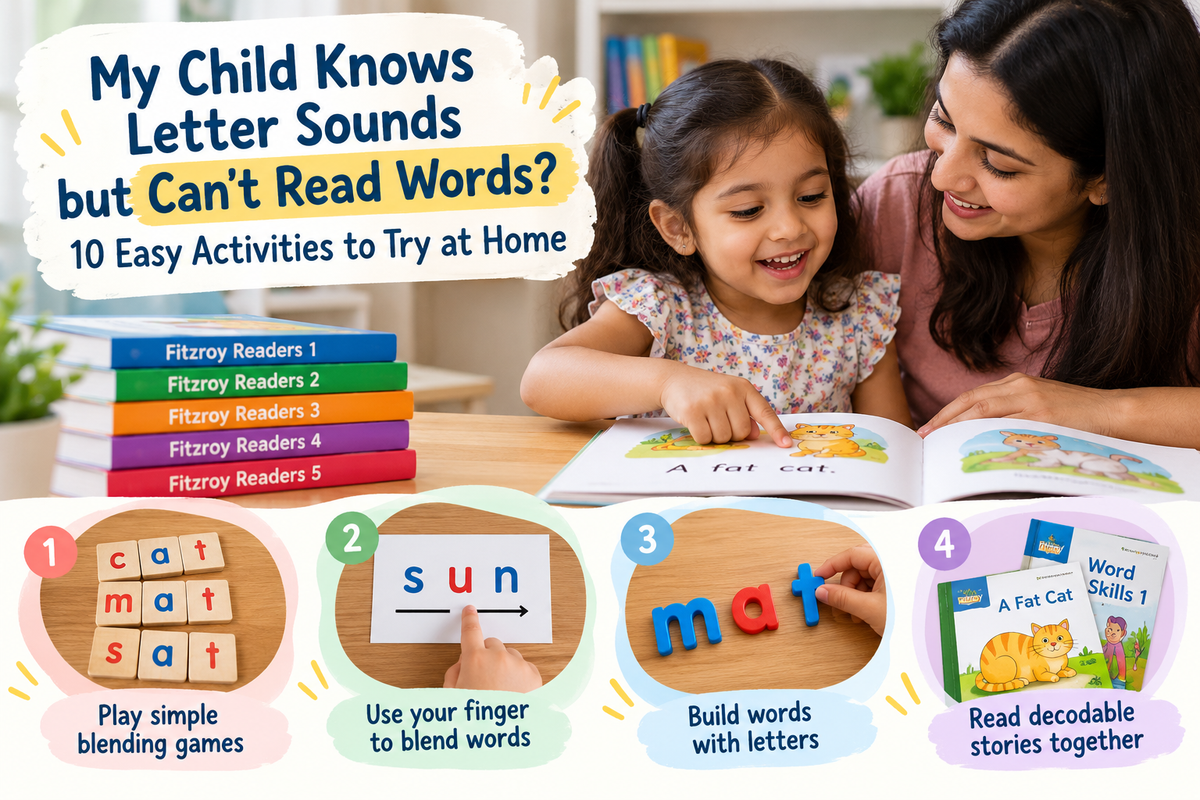
If your child is interested in letters but cannot blend sounds yet, begin with simple sound games.
You can try:
-
Practising a small set of familiar sounds.
-
Playing oral blending games.
-
Building simple words with magnetic letters.
-
Reading interesting picture books aloud together.
-
Introducing decodable text once the child has the necessary foundations.
For example, try these three-letter words:
| Word | Practice Activity |
|---|---|
| cat | Say each sound and blend |
| mat | Change C to M |
| sat | Change M to S |
| bat | Change S to B |
This can help children understand how changing one letter changes a word.
Avoid choosing advanced reading books simply because the cover says they're suitable for four-year-olds.
How to Use Phonics Books at Home
You don't need to turn every reading session into a long lesson.
Here's a simple approach:
Step 1: Review a few sounds your child already knows.
Step 2: Practise blending two or three simple words.
Step 3: Read a short, appropriately decodable passage together.
Step 4: Help with unfamiliar spelling patterns or words.
Step 5: Talk about the story and ask a simple question.
If your child enjoys writing, finish with a short matching workbook activity.
Five to ten minutes may be a manageable starting point for some families, but adjust the session to your child's interest and abilities.
Five Mistakes to Avoid When Buying Phonics Books
1. Choosing Books Only by Age
Two children of the same age may be at very different reading stages.
Look at the skills required, not just the recommended age.
2. Buying Too Many Levels at Once
You may not yet know which patterns your child needs to practise.
Start with a suitable level and evaluate progress before buying more.
3. Expecting a Book to Teach Everything Independently
Early readers often benefit from an adult modelling sounds and supporting unfamiliar words.
4. Using Only Workbooks
Written activities can be helpful, but children also need opportunities to read actual text.
5. Forgetting About Enjoyment
Continue reading funny, interesting and imaginative stories aloud, even when they're above your child's independent reading level.
How to Know If Your Child Is Ready for Phonics Readers
Before buying their first reading set, try this simple activity.
Write the words:
mat — sat — pin
Ask your child to identify the letter sounds and blend each word.
If they can sound out these words with some help, they may be ready to practise in appropriately matched beginner readers.
If they cannot yet blend the sounds, spend more time on oral blending and letter games.
This is an informal observation, not a formal reading assessment.
The right starting level depends on which phonics patterns your child already knows.
Frequently Asked Questions
Which phonics books are best for beginners in India?
Look for decodable books with a clearly explained progression and patterns matched to your child's current skills. Fitzroy Readers is one structured series to consider, along with other decodable books available through libraries and educational suppliers.
You can browse phonics reading resources at VIDYA VITRAN LEARNING.
Should I buy phonics books for a three-year-old?
A three-year-old may enjoy rhymes, sound games, letter activities and shared storybooks. Whether to introduce decodable readers depends on their interest and current letter-sound knowledge.
Do phonics books help with English pronunciation?
Phonics books can support recognising spelling-sound relationships and practising spoken reading. Reading aloud with appropriate guidance or audio support may provide additional practice, though outcomes vary by child.
Are phonics readers and storybooks the same?
Not necessarily. Decodable phonics readers are designed around specified spelling patterns, while ordinary storybooks may include a much wider range of vocabulary and spellings.
Both can be valuable for different purposes.
Are workbooks necessary for phonics?
No. They are optional practice resources. Oral games, letter cards, decodable reading and shared storytime can all be part of home learning.
Should I buy a phonics reader and workbook together?
It depends on your child's learning needs.
A reader provides opportunities to practise decoding in stories, while a workbook may reinforce related spelling and writing skills.
Some families find it helpful to combine both, while others prefer to begin with reading books and add practice materials later.
Final Thoughts: Choose Books That Help Your Child Grow
The right phonics book isn't necessarily the most expensive set or the one with the most pages.
It's a book your child can begin to read using the skills they've already learned, with enough challenge to continue developing.
Start with the sounds your child knows, choose a manageable reading level and gradually introduce new patterns.
And keep reading for enjoyment alongside formal practice.
Every child learns at their own pace. The goal isn't to finish more books. It's to help them become confident, curious readers.
Explore Beginner Reading Resources at VIDYA VITRAN LEARNING
If you're comparing structured phonics resources for home learning, explore:
-
Fitzroy Phonics Readers Stories 1–10 — For early decoding and reading practice.
-
Four Ways to Grow Learning Bundle — For families interested in reading and additional learning activities.
-
Phonics Books Collection — To explore available phonics materials.
-
Children's Reading Books — To browse additional reading resources.
Help your child enjoy learning, one sound, one word and one story at a time.
Published by VIDYA VITRAN LEARNING — Children's Educational Books, Phonics Readers and Learning Resources.